
Hampshire Controls Corporation provides monitoring, alarm, data logging, and notification systems for applications where temperature and other operating conditions are critical. Since 1976, the company has designed and manufactured NIST-traceable monitoring equipment in the USA for blood banks, hospitals, laboratories, cryogenic storage, food processing, and other applications.
Each facility has unique monitoring requirements, but dependable temperature information is universally important. A temperature change in a blood storage refrigerator, laboratory freezer, liquid nitrogen Dewar, hospital refrigerator, or food storage area can impact valuable materials and inventory. Hampshire Controls offers temperature monitoring systems with options for continuous readings, high- and low-temperature alarms, multi-probe monitoring, data logging, and remote alert notifications.
Our monitoring equipment supports applications such as:
- Blood bank storage and blood product temperature verification
- Cryogenic biologic storage and liquid nitrogen monitoring
- Laboratory monitoring and data logging
- Clinical temperature and other condition monitoring
- Food and beverage storage, refrigeration, and freezer monitoring
Blood Bank Storage
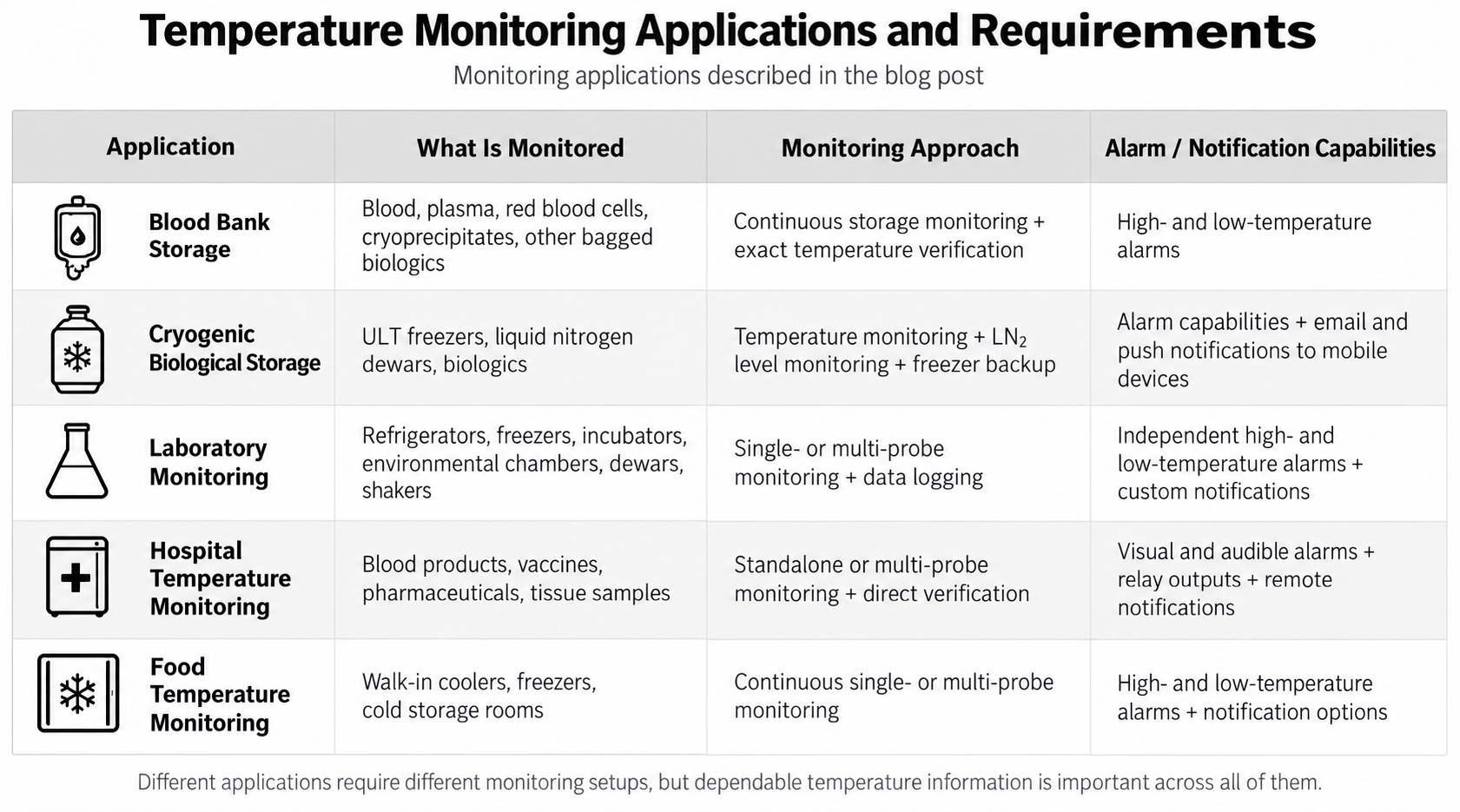
Blood banks handle products that require controlled storage, including whole blood, red blood cells, platelets, fresh frozen plasma, cryoprecipitates, and other bagged biologics. Temperature verification helps personnel confirm conditions when products arrive, leave storage, or are returned to a controlled environment.
Hampshire Controls provides temperature monitoring systems for blood bank applications as well as equipment for direct temperature verification. Its Blood/Plasma Rapid Response Thermometers provide a practical way to rapidly verify the temperature of an individual blood bag without relying on slower temperature measurement methods.
The TC-25+ TEMPCHECK Rapid Response Thermometer is a digital, non-invasive thermometer for blood, plasma, red blood cells, cryoprecipitates, and other bagged biologics. It provides rapid temperature readings, out-of-range audio and visual alarms, barcode scanning, and temperature/barcode recording for blood products being received, removed from storage, or returned to storage.
The thermometer can also be used for plasma and platelet bags in operating rooms, blood banks, and other clinical settings. Personnel can take an accurate and precise temperature reading of the blood product directly at the point of use.
Direct temperature checks can work alongside fixed monitoring equipment. Hampshire Controls Model 140 and MPS temperature monitors continuously track storage conditions and can activate high- or low-temperature alarms based on user-defined limits. This provides facilities with ongoing monitoring as well as direct verification when blood products are moved or handled.
Cryogenic Biologic Storage
Cryogenic storage requires monitoring equipment capable of operating at extremely low temperatures. IVF cells, living cells, tissues, vaccines, biological reagents, and other biologics may be stored in ultra-low-temperature freezers or liquid nitrogen Dewars.
Hampshire Controls supports ULT freezer applications from approximately -20°C to -90°C and liquid nitrogen storage from approximately -150°C to -196°C. Its cryogenic monitoring equipment provides temperature monitoring and alarm capabilities for these demanding storage conditions.
Liquid nitrogen is commonly used for cryogenic storage, but its level must be monitored because evaporation can cause the level to fall and storage conditions to change. Hampshire Controls’ LD-215 Liquid Nitrogen Level Detector/Alarm uses a cryogenic RTD probe to detect changes associated with falling LN₂ levels.
For facilities with multiple dewars, MPS multi-probe systems can monitor several locations at the same time. Email and push notifications to mobile devices are also available for alarm conditions, helping personnel respond in a timely manner..
Monitoring is one part of protecting biological materials. A freezer failure or power outage can quickly impact storage temperatures, so Hampshire Controls also provides liquid CO₂ (CA5000-C) and liquid nitrogen (CA5000-N) freezer backup systems.
The CA5000-C and CA5000-N systems with battery backup can automatically introduce liquid cryogenic coolant when a biomedical freezer experiences mechanical failure, coolant loss, or a power outage. These temperature alarm systems with cryogenic liquid injection for freezer backup provide additional protection for materials stored at ultra-low temperatures.
Laboratory Monitoring
Laboratories may have refrigerators, freezers, incubators, environmental chambers, dewars, and other equipment that require continuous monitoring. Hampshire Controls offers temperature monitoring systems that can be configured with single or multiple probes.
Hampshire Controls’ MPS system supports up to 8 temperature monitoring channels with independent high- and low-temperature alarm limits. This allows laboratory personnel to monitor several storage locations through one monitoring system.
Continuous monitoring provides an ongoing record of temperature conditions, and Hampshire Controls’ T° Sentry ALERT Monitoring System provides PC-based data logging and alarm notification and can interface with several of our monitoring products. For laboratories managing research materials, the T° Sentry ALERT Monitoring System provides access to current conditions while notifying personnel when temperatures move outside programmed limits.
Laboratory monitoring can also include airflow. Hampshire Controls manufactures Air Flow Monitors for biocontainment cabinets, fume hoods, laminar flow hoods, and ventilation systems. The AFM provides continuous airflow monitoring with audible and visual alarms and relay output for remote alarm systems.
Hospital Temperature Monitoring
Hospitals use controlled storage for blood products, vaccines, pharmaceuticals, tissue samples, and other temperature-sensitive materials. Refrigerators and freezers used for these products require monitoring so personnel can respond when conditions move outside acceptable limits.
Hampshire Controls provides equipment for continuous storage monitoring as well as direct temperature verification. The TC-25+ TEMPCHECK Rapid Response Thermometers are used to verify the temperature of blood and plasma bags in hospitals, blood banks, transfusion services, and clinical laboratories.
Hampshire Controls supplies temperature monitoring systems for hospitals that can be configured with a single probe for individual storage units or multiple probes for monitoring several locations simultaneously. The MPS systems support up to 8 temperature monitoring channels with independent low- and high-temperature alarm limits.
These capabilities allow facilities to select the best temperature monitoring solution based on the number of locations being monitored and the type of notification required. A single refrigerator may use a standalone single-channel monitor, while a larger facility can use multi-probe equipment with data logging and remote alerts.
Alarm notification helps hospital personnel identify temperature excursions quickly. Depending on the system, Hampshire Controls equipment can provide visual and audible alarms, relay outputs, and remote email and push notifications to mobile devices.
Food Temperature Monitoring
Food processors, commercial kitchens, distribution facilities, and storage operations depend on refrigerated and freezing environments to protect temperature-sensitive inventory. Walk-in coolers, freezers, cold storage rooms, and other refrigerated areas also benefit from continuous temperature monitoring.
Food temperature monitoring systems from Hampshire Controls provide continuous visibility into storage conditions and can notify personnel when temperatures move outside of programmed limits.
Our Model 140 is a continuously monitoring single-probe system used in applications such as laboratory refrigerators, freezers, and walk-in coolers. For facilities monitoring several areas, multi-probe MPS systems can provide readings from multiple locations.
Temperature alarm systems provide an active warning when monitored conditions move outside established high or low limits. Depending on the configuration, Hampshire Controls systems can use audible and visual alarms, relay outputs, and other notification options.
For food storage operations, these alerts can help personnel to rapidly identify refrigeration or freezer problems and to take action before a larger quantity of inventory is impacted.
Choosing the Right Monitoring Approach
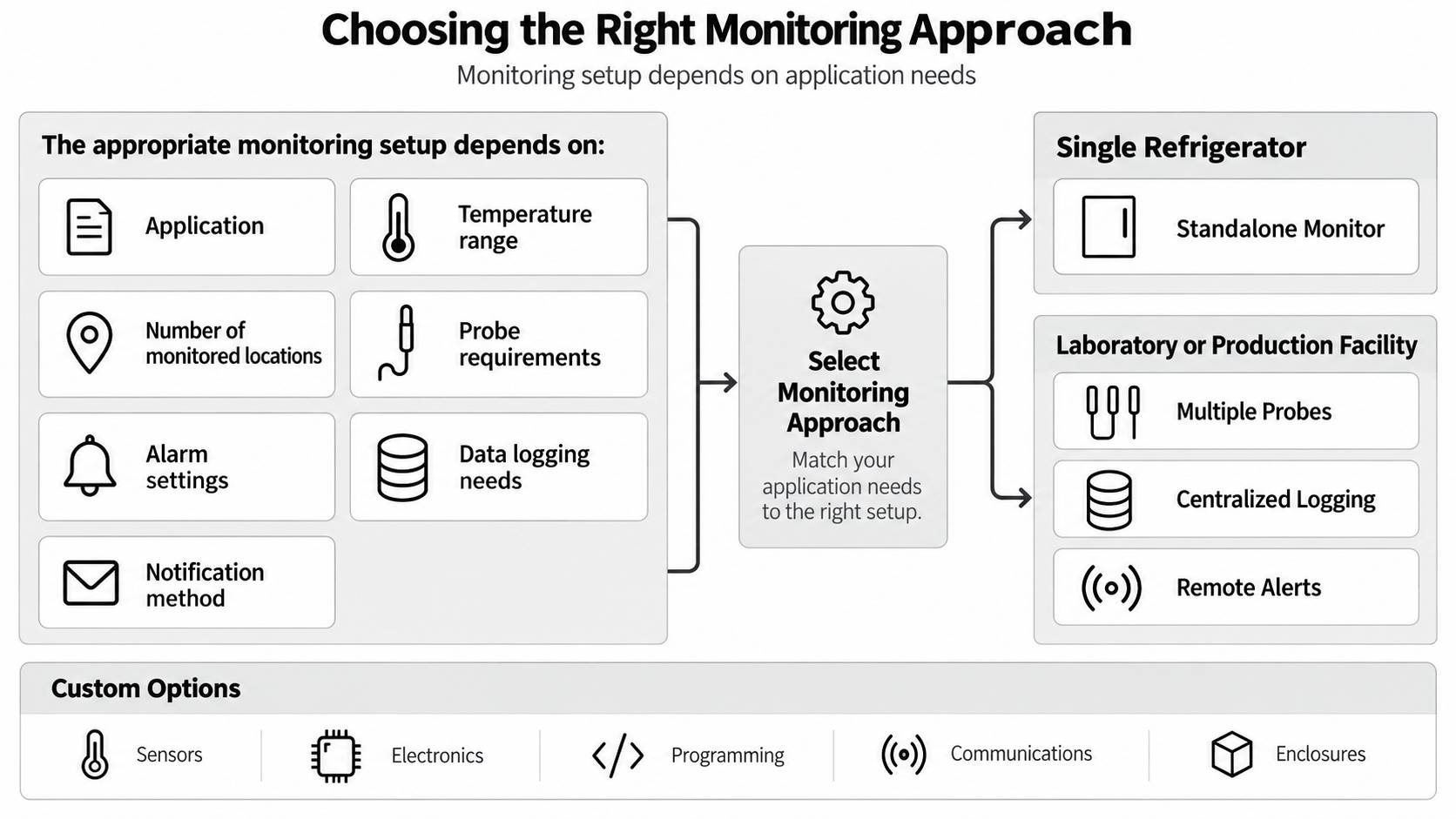
The appropriate monitoring system depends on the application, temperature range, number of monitored locations, probe requirements, alarm settings, data logging needs, and notification requirements.
A single refrigerator may require a standalone monitor, while a laboratory or production facility may demand multiple probes with centralized logging and remote alerts.
Hampshire Controls also provides custom engineering and manufacturing services for OEMs, laboratories, government agencies, and industrial manufacturers. Custom options can include sensors, electronics, programming, communications, and enclosures.
Monitoring Built Around the Application
Blood banks, hospitals, laboratories, cryogenic storage facilities, and food operations all have different monitoring requirements. Hampshire Controls provides temperature monitoring systems, alarm equipment, data logging, liquid nitrogen level monitoring, and freezer backup systems for these applications.
With standard and custom options, NIST-traceable monitoring, and products manufactured in Dover, New Hampshire in the USA, Hampshire Controls can support facilities that demand dependable information about critical storage conditions. Contact Hampshire Controls to discuss the monitoring, alarm, or data logging requirements for your application.